Build a Multi-Framework Compliance Roadmap Without Tripling the Work
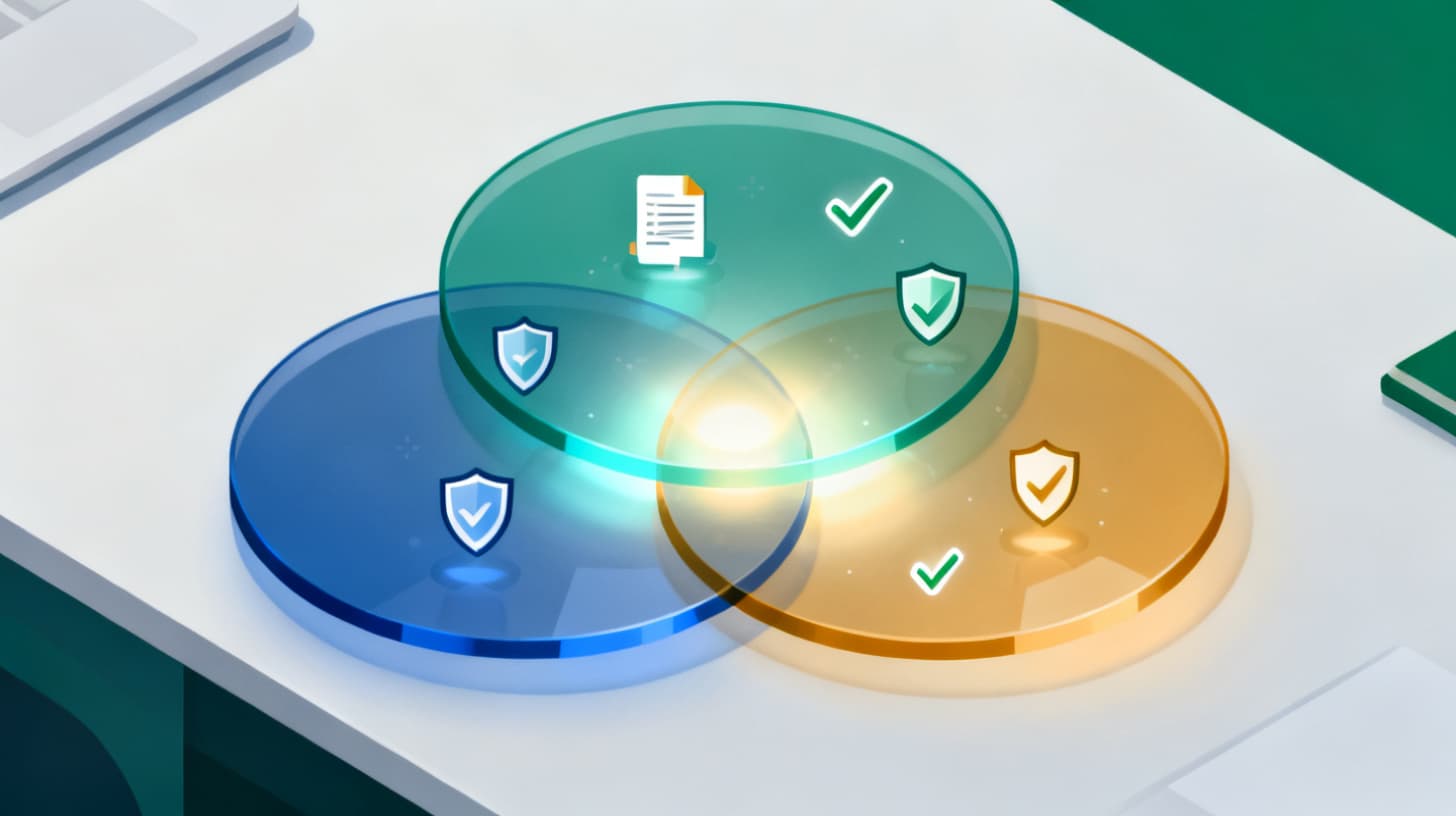
Learn how to build a multi-framework compliance roadmap across SOC 2, ISO 27001, and ISO 42001 by mapping shared controls and reusing evidence artifacts.
Most startups pick SOC 2 as their first compliance framework because enterprise buyers demand it. Then a European prospect asks about ISO 27001. Then the AI governance conversation starts, and suddenly ISO 42001 is on the table. Before you know it, your security team is staring at three separate audit scopes, three sets of controls, and a budget that didn't account for any of this.
Here's the thing nobody tells you early enough: these frameworks overlap by roughly 60 to 80 percent. The controls you implement for SOC 2 Trust Services Criteria feed directly into ISO 27001 Annex A domains. And ISO 42001, the newer AI management system standard, builds on the same management system architecture as ISO 27001 with targeted additions for AI risk. If you map shared controls from the start, you don't triple the work. You add maybe 30 to 40 percent effort for each additional framework.
This guide walks through exactly how to build that multi-framework roadmap. You'll learn where the control overlaps live, how to sequence your compliance efforts, and how to produce reusable evidence that satisfies multiple auditors at once. If you're already looking at generating policies and evidence across SOC 2, ISO 27001, and other frameworks, PentestToday can produce that mapped evidence in hours rather than weeks.
Let's break this down into a plan you can actually execute.
Map the Control Overlaps Before You Write a Single Policy
The biggest mistake engineering teams make is treating each framework as an isolated checklist. They'll write an access control policy for SOC 2, then write a slightly different one for ISO 27001, and then write yet another variant when ISO 42001 enters the picture. Three policies. Three review cycles. Three maintenance burdens. All covering essentially the same ground.
A smarter approach starts with a control mapping exercise. You take the control domains from each framework and identify where they ask for the same thing using different language.
Where SOC 2 and ISO 27001 Converge
SOC 2's Trust Services Criteria organize around five categories: Security, Availability, Processing Integrity, Confidentiality, and Privacy. ISO 27001's Annex A (updated in the 2022 revision) groups 93 controls into Organizational, People, Physical, and Technological categories. Despite the different taxonomies, the overlap is substantial.
Consider access control. SOC 2 criterion CC6.1 requires logical access security over information assets. ISO 27001 control A.8.3 addresses access restriction to information. Both require you to define who gets access to what, enforce least privilege, and review permissions periodically. One well-written access control policy, backed by the same technical controls (SSO configuration, role-based access, quarterly access reviews), satisfies both frameworks.
The same convergence appears across risk assessment (CC3.1 maps to clause 6.1 in ISO 27001), incident response (CC7.3 maps to A.5.24 through A.5.28), change management (CC8.1 maps to A.8.32), and encryption standards (CC6.1 maps to A.8.24). When you plot these mappings in a matrix, you'll typically find that 70 to 80 percent of SOC 2 controls have a direct or near-direct ISO 27001 counterpart.
You can browse real examples of policies structured this way in the Security Policy Library, where templates for access control, cryptography, incident response, and more are already mapped to multiple compliance frameworks.
Where ISO 42001 Adds New Ground
ISO 42001 is the first international standard specifically addressing AI management systems. It follows the same Annex SL high-level structure as ISO 27001, which means the management system clauses (context, leadership, planning, support, operation, performance evaluation, improvement) are architecturally identical. If you've already built an ISO 27001 management system, you have the skeleton for ISO 42001.
The delta lives in AI-specific controls. ISO 42001 introduces requirements around:
- AI impact assessment that evaluates societal, individual, and organizational risks from AI systems
- Data quality management for training and inference data, going beyond traditional data classification
- Transparency and explainability controls that document how AI systems make decisions
- AI system lifecycle management covering design, development, deployment, monitoring, and retirement
- Human oversight mechanisms ensuring appropriate human-in-the-loop or human-on-the-loop governance
These AI-specific controls map closely to the NIST AI Risk Management Framework, which provides voluntary guidance on AI trustworthiness. If you're already aligning with NIST AI RMF for U.S. regulatory conversations, you'll find significant overlap with ISO 42001's Annex B and Annex C guidance.
The practical takeaway: build your control mapping matrix before touching a single policy document. Use a spreadsheet or database with columns for the control objective, SOC 2 reference, ISO 27001 reference, ISO 42001 reference, the responsible owner, and the evidence artifact. This single artifact becomes your roadmap's foundation.
Sequence Your Compliance Efforts for Maximum Reuse
Once you've mapped where frameworks overlap, the next question is sequencing. Which framework do you tackle first? How do you layer on additional frameworks without reworking what you've already built?
The answer depends on your business context, but a pattern works well for most software companies.
Start With SOC 2 Type I as Your Foundation
SOC 2 is typically the fastest path to a compliance report that enterprise buyers will accept. A Type I audit evaluates whether your controls are designed appropriately at a point in time. You don't need months of operational evidence. You need well-designed policies, properly configured controls, and documentation proving they exist.
For engineering teams, this means focusing on:
- 1.Core policies covering access control, change management, incident response, risk assessment, vendor management, data classification, and acceptable use
- 2.Technical controls like SSO/MFA enforcement, infrastructure-as-code with version control, automated vulnerability scanning, encrypted data at rest and in transit, and centralized logging
- 3.Process documentation for onboarding, offboarding, code review, deployment pipelines, and incident handling
If you're building these from scratch, the SOC 2 for Startups guide provides a realistic cost, timeline, and policy checklist to work from. The key is writing every policy and control description with multi-framework language from day one. Instead of referencing only SOC 2 criteria, include parallel references to ISO 27001 Annex A controls in your policy metadata.
Layer ISO 27001 Certification Next
With SOC 2 Type I complete, you've already implemented roughly 70 percent of what ISO 27001 requires. The gap analysis is straightforward:
- Management system formalities: ISO 27001 requires a formal ISMS (Information Security Management System) with documented scope, risk treatment plan, Statement of Applicability, management review records, and internal audit evidence. SOC 2 doesn't prescribe this management system wrapper.
- Risk assessment methodology: While SOC 2 requires risk assessment, ISO 27001 is more prescriptive about the methodology. You need a documented risk assessment process that identifies information security risks, evaluates likelihood and impact, and produces a risk treatment plan.
- Physical security controls: If you're a cloud-native company relying on AWS or GCP, many physical controls are inherited from your cloud provider. But you'll need to document this inheritance explicitly.
- Supplier relationship management: ISO 27001 A.5.19 through A.5.23 are more detailed than SOC 2's vendor management expectations.
The effort to close these gaps is incremental, not exponential. You're adding a management system structure around controls you've already implemented, not rebuilding from scratch.
Add ISO 42001 for AI Governance
If your product uses machine learning models, generative AI, or automated decision-making, ISO 42001 is the natural third layer. Because it shares the Annex SL management system structure with ISO 27001, your ISMS expands rather than duplicates.
The new work centers on AI-specific artifacts:
- An AI policy stating your organization's commitment to responsible AI
- AI impact assessments for each AI system in production or development
- Documentation of training data provenance, quality criteria, and bias evaluation
- Explainability documentation appropriate to each AI system's risk level
- Monitoring procedures for model drift, performance degradation, and unintended outputs
- Human oversight procedures defining when and how humans review AI outputs
Notice that several of these artifacts feed naturally into SOC 2 evidence as well. Your AI monitoring procedures support SOC 2's processing integrity and availability criteria. Your data quality documentation supports confidentiality criteria. Multi-framework thinking means every artifact serves double or triple duty.
Build a Shared Evidence Library That Satisfies All Three Auditors
Policies and controls are only half the story. Auditors want evidence. They want to see that your controls actually operate as documented, that people follow the policies, and that management reviews the whole program periodically.
The secret to not tripling this work is building a shared evidence library with clear cross-references.
Structure Evidence Around Control Objectives, Not Frameworks
Instead of organizing evidence into "SOC 2 evidence" and "ISO 27001 evidence" folders, organize by control objective. Create a structure like this:
| Control Objective | Evidence Artifact | SOC 2 Ref | ISO 27001 Ref | ISO 42001 Ref |
|---|---|---|---|---|
| Access provisioned via least privilege | SSO config screenshots, RBAC role definitions, quarterly access review logs | CC6.1, CC6.2 | A.5.15, A.8.3 | Inherited |
| Vulnerabilities identified and remediated | Scan reports, remediation tickets, SLA compliance metrics | CC7.1 | A.8.8 | Inherited |
| AI system outputs monitored for accuracy | Model monitoring dashboard, drift detection alerts, human review logs | CC7.2 (processing integrity) | A.8.16 | Annex A, A.6.2.6 |
| Incidents detected and responded to | Incident tickets, postmortem reports, communication logs | CC7.3, CC7.4 | A.5.24, A.5.25 | Inherited + AI incident addendum |
| Changes tested before deployment | CI/CD pipeline configs, code review records, deployment approval logs | CC8.1 | A.8.32 | Inherited |
This table format means when your SOC 2 auditor asks for access control evidence, you point them to the same artifacts your ISO 27001 certification body reviews. No duplicate folders. No conflicting versions.
Automate Evidence Collection Where Possible
Manual evidence gathering is where multi-framework compliance actually triples the work, not in policy writing. If you're pulling screenshots for every audit manually, three frameworks means three times the screenshots.
Automate ruthlessly:
- Access reviews: Use your identity provider's reporting API to generate quarterly access review exports automatically
- Vulnerability scans: Schedule recurring scans and pipe results into a central repository. PentestToday's security packet generator can produce scan summaries, pentest reports, and architecture diagrams as audit-ready documents
- Change management: Your Git history and CI/CD logs are evidence. Configure exports or dashboards that auditors can review
- Training completion: Use your LMS or HR platform to export completion records, not manual spreadsheets
- Incident response: Ensure your ticketing system captures enough metadata (timestamps, assignees, severity, resolution steps) to serve as evidence without additional documentation
The goal is evidence that generates itself through normal engineering operations. When you add ISO 42001 to the mix, you're adding monitoring dashboards for AI systems and AI impact assessment documents to this same library, not building a parallel evidence infrastructure.
Handle the Audit Logistics
One practical consideration that catches teams off guard: audit timing. If you run SOC 2 Type II on a calendar-year observation period, try to align your ISO 27001 surveillance audit and ISO 42001 certification audit windows so they draw from overlapping evidence periods. This isn't always possible, but when it works, you collect evidence once and present it to multiple auditors.
Also consider whether your auditing firm can conduct combined assessments. Some certification bodies are accredited for both ISO 27001 and ISO 42001, which means a single audit team can evaluate both management systems in one engagement. The cost savings are meaningful, and the logistics are dramatically simpler.
Turn Your Roadmap Into a Living Program
A compliance roadmap that lives in a slide deck and gets referenced once a quarter isn't a program. It's a liability. The frameworks you're implementing all emphasize continual improvement, which means your roadmap needs to evolve as your product, team, and threat landscape change.
Start by assigning clear ownership. Every control in your mapping matrix should have a named owner, not a team, but a person. When the access control policy needs updating because you migrated identity providers, the owner drives that change. When an AI impact assessment needs refreshing because you deployed a new model, the owner initiates the review.
Build review cadences into your existing engineering rituals. Monthly security syncs can double as management review inputs for ISO 27001 and ISO 42001. Sprint retrospectives can capture improvement opportunities that feed the continual improvement clause both ISO standards require. Quarterly risk reviews update your risk treatment plan and SOC 2 risk assessment simultaneously.
For teams building policies from scratch or refreshing outdated ones, writing multi-framework policies doesn't require starting from blank documents. You can build security policies that satisfy SOC 2, ISO 27001, and HIPAA at once using a shared control approach.
Finally, track your roadmap progress with metrics that matter:
- Percentage of controls implemented vs. planned
- Number of evidence artifacts that serve multiple frameworks
- Mean time to produce evidence for a given control
- Gap count remaining per framework
- Days since last management review
These metrics tell you whether your multi-framework approach is actually reducing effort or whether siloed thinking has crept back in.
The path from one framework to three doesn't have to mean three times the budget, three times the policies, or three times the headaches. Map your overlaps early, sequence your efforts strategically, build a shared evidence library, and keep the program alive with clear ownership and regular review. If you're ready to generate the policies, scan reports, and compliance evidence you need across SOC 2, ISO 27001, and beyond, start building your security packet today.
Get a Pentest in 24 hours or less
Our agent swarm and human experts test your endpoints and deliver an audit, fast.