Build Your First Security Policy Library for SOC 2 or ISO 27001
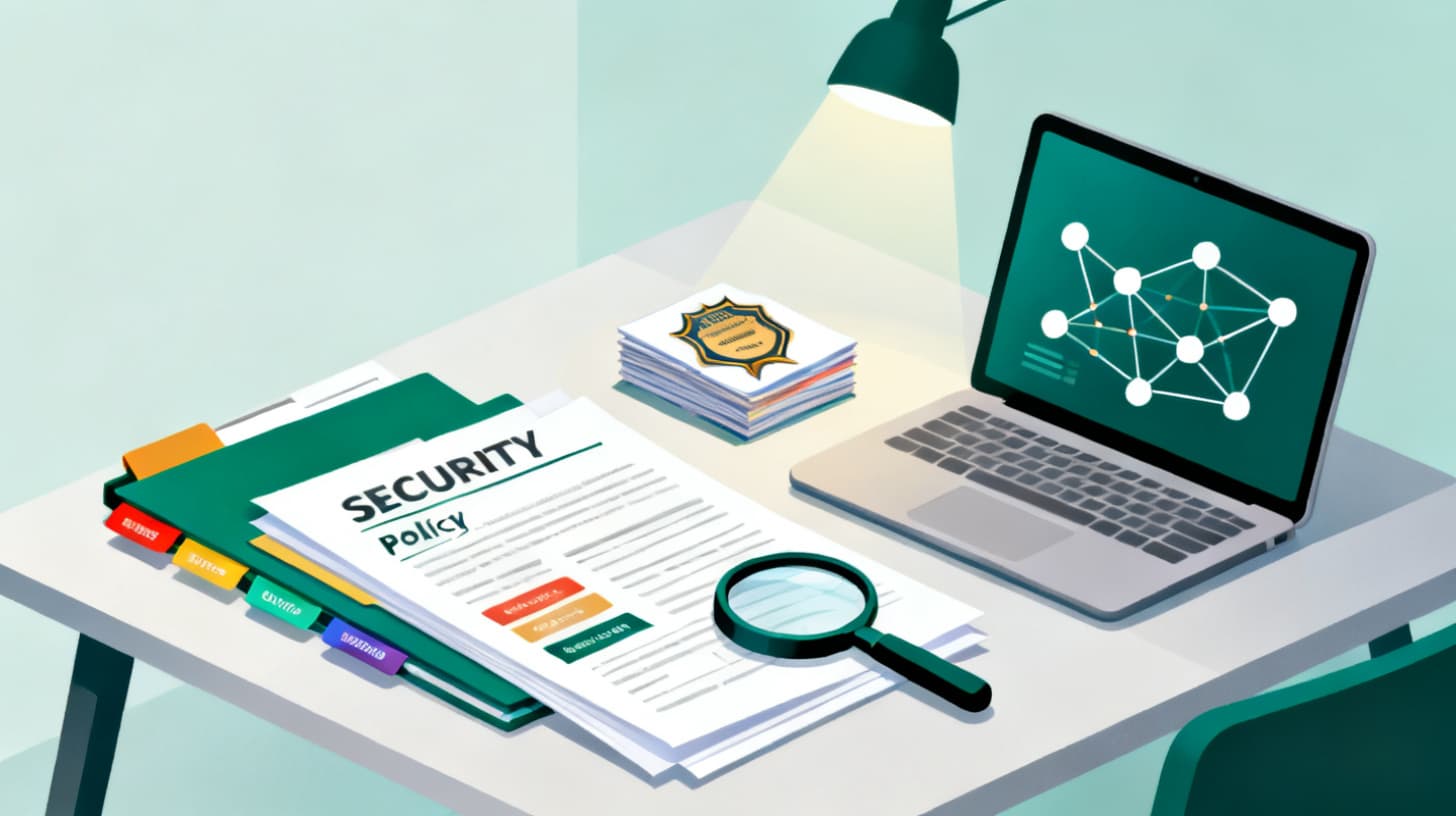
Learn how to build a security policy library from scratch for SOC 2 and ISO 27001 with practical templates, structure tips, and an audit-ready checklist.
A startup founder walks into an enterprise sales call, confident the product demo will close the deal. Then the procurement team sends over a 200-question security questionnaire asking for evidence of an access control policy, an incident response plan, a data classification standard, and a dozen more documents the company has never written. The deal stalls. Sound familiar?
This scenario plays out thousands of times a year, and it doesn't have to. Building a security policy library isn't some Herculean task reserved for companies with dedicated GRC teams. With the right approach, a single engineer or security-minded founder can stand up a policy library that satisfies SOC 2 Trust Services Criteria, maps to ISO 27001 Annex A controls, and unblocks enterprise revenue. Pentest Today was built specifically for this workflow, letting startups generate over 20 mapped policy templates in minutes instead of months. But whether you use tooling or start from a blank document, the principles below will get you from zero policies to audit-ready.
Let's break down exactly what belongs in a security policy library, how to structure it so auditors and enterprise buyers can actually navigate it, and where most teams waste time (so you don't).
Understanding What a Security Policy Library Actually Contains
Before you create a single document, you need to understand the difference between policies, standards, procedures, and guidelines. Mixing these up is the number one reason early-stage policy libraries become bloated, contradictory messes that auditors flag immediately.
Policies are high-level statements of intent. They answer the question "what do we commit to doing?" A policy is approved by leadership and rarely changes. Example: "All production data must be encrypted at rest and in transit."
Standards define the specific technical or operational bar. They answer "how well must we do it?" Example: "Encryption at rest must use AES-256. TLS 1.2 is the minimum for data in transit."
Procedures are step-by-step instructions for carrying out a standard. Example: "To rotate the database encryption key, run the following CLI command, verify the new key fingerprint, and update the secrets manager entry."
Guidelines are recommendations that aren't mandatory. Example: "When possible, prefer hardware security modules over software-based key storage."
SOC 2 and ISO 27001 auditors both look for this hierarchy, though they use slightly different language. SOC 2 maps controls to five Trust Services Criteria (Security, Availability, Processing Integrity, Confidentiality, Privacy), while ISO 27001 references 93 controls across four themes in Annex A. The good news: roughly 70% of the policy content overlaps. If you write your library once with both frameworks in mind, you avoid duplicating effort later.
The Core Policy Set You Need
Here's the practical list of policies most SOC 2 and ISO 27001 audits expect to see:
| Policy Document | SOC 2 Criteria | ISO 27001 Annex A |
|---|---|---|
| Information Security Policy | CC1.1, CC1.2 | A.5.1, A.5.2 |
| Access Control Policy | CC6.1, CC6.2, CC6.3 | A.5.15, A.8.2, A.8.3 |
| Data Classification & Handling | CC6.5, C1.1 | A.5.12, A.5.13 |
| Incident Response Plan | CC7.3, CC7.4, CC7.5 | A.5.24, A.5.25, A.5.26 |
| Business Continuity & Disaster Recovery | A1.2, A1.3 | A.5.29, A.5.30 |
| Change Management Policy | CC8.1 | A.8.32 |
| Risk Assessment & Treatment | CC3.1, CC3.2 | A.5.3 (clause 6.1) |
| Vendor / Third-Party Management | CC9.2 | A.5.19, A.5.20, A.5.21 |
| Acceptable Use Policy | CC1.4, CC6.8 | A.5.10 |
| Cryptography Policy | CC6.1, CC6.7 | A.8.24 |
| Physical Security Policy | CC6.4 | A.7.1 through A.7.4 |
| Human Resources Security | CC1.4 | A.6.1 through A.6.6 |
| Logging & Monitoring Policy | CC7.1, CC7.2 | A.8.15, A.8.16 |
| Secure Development (SDLC) Policy | CC8.1 | A.8.25, A.8.26, A.8.27 |
| Asset Management Policy | CC6.1 | A.5.9, A.5.11 |
You can browse the full set of templates, including network security, privacy, and vulnerability management, in the PentestToday Security Policy Library. Seeing finished examples makes the drafting process dramatically faster because you can model structure and language instead of staring at a blank page.
The NIST Cybersecurity Framework 2.0 Small Business Quick-Start Guide organizes these concerns into six functions: Govern, Identify, Protect, Detect, Respond, and Recover. If you align your policy library to these functions, you'll find that SOC 2 and ISO 27001 controls slot neatly into the same structure. Think of NIST as the skeleton and the individual policies as the organs.
Writing Policies That Auditors and Enterprise Buyers Trust
A policy that exists in a Google Doc titled "security stuff v3 FINAL (2)" is worse than no policy at all, because it signals to an auditor that governance is an afterthought. The content matters, but so does how you structure, version, and present each document.
Anatomy of a Well-Structured Policy
Every policy document should follow a consistent template. Here's the format that auditors from the Big Four and boutique SOC 2 firms both recognize:
- 1.Header block with policy title, version number, effective date, document owner, and next review date.
- 2.Purpose section (2-3 sentences explaining why this policy exists).
- 3.Scope section defining who and what the policy covers. Be specific: "All employees, contractors, and third-party vendors with access to production systems" is better than "everyone."
- 4.Policy statements organized by control objective. Use clear, imperative language: "The engineering team SHALL rotate API keys every 90 days" rather than "API keys should probably be rotated sometimes."
- 5.Roles and responsibilities table mapping each obligation to a specific role (not a person's name, which changes constantly).
- 6.Exceptions process describing how to request, document, and time-limit any deviation from the policy.
- 7.Compliance and enforcement section noting consequences of non-adherence.
- 8.Revision history table showing every change, who approved it, and when.
This structure works because auditors can quickly verify three things: the policy says what you'll do, it assigns accountability, and it has a mechanism for evolution. Missing any of these three pieces triggers findings.
Common Mistakes to Avoid
The biggest trap is copying someone else's policies word-for-word. Template-based starting points are fine (and recommended), but if your Access Control Policy references Active Directory and LDAP while your company runs entirely on Okta and AWS IAM, the auditor will notice. Every policy must reflect your actual environment, tooling, and team structure.
Here are more pitfalls that trip up first-time policy authors:
- Overpromising. If you write that you perform quarterly penetration tests but you've never run one, you've just created an audit finding against yourself. Only commit to what you can actually do or will do before the audit window.
- Being too vague. "We take security seriously" is not a policy statement. "All production databases are backed up daily with a 30-day retention period and monthly restoration tests" is.
- Ignoring review cadence. Both SOC 2 and ISO 27001 require policies to be reviewed at a defined interval, typically annually. If your revision history shows a policy hasn't been touched in three years, that's a gap.
- Siloing ownership. The CISO (or whoever owns security) should approve policies, but the engineering lead should own the SDLC policy, the HR lead should own HR security, and so on. Distributed ownership means distributed accountability.
If you want to see how a unified policy library maps to SOC 2, ISO 27001, HIPAA, and more simultaneously, the guide on building policies that satisfy multiple frameworks at once walks through the overlap in detail.
From Draft to Audit-Ready: The Implementation Workflow
Writing policies is only half the battle. The other half is proving you actually follow them. Auditors call this "operating effectiveness," and it's where most startups stumble during their first SOC 2 Type II or ISO 27001 surveillance audit.
Step 1: Inventory Your Current State
Before you write anything, catalog what you already have. Most engineering teams are already doing security-relevant work without labeling it as policy compliance. You probably have:
- Branch protection rules and required code reviews (maps to Change Management)
- SSO or MFA enforced through your identity provider (maps to Access Control)
- Automated backups through your cloud provider (maps to BCDR)
- Dependency scanning in your CI/CD pipeline (maps to Vulnerability Management)
Document these existing practices first. Then identify the gaps where you have no process, no tool, and no documentation. Those gaps become your priority drafting list.
Step 2: Draft, Review, Approve
For each policy, follow this flow:
- 1.Draft the document using the template structure above. Start with your highest-risk gaps. If you're pursuing SOC 2, access control and incident response are almost always examined first.
- 2.Peer review with the team responsible for implementing the policy. An incident response plan that the on-call engineer has never seen is useless.
- 3.Leadership approval with a documented sign-off. This can be as simple as an email thread or a signature field in your document management system. The point is to show that someone with authority formally blessed the policy.
Timing tip: start with the five highest-impact policies (Information Security, Access Control, Incident Response, BCDR, and Change Management). These five alone cover roughly 60% of SOC 2 Common Criteria and a significant chunk of ISO 27001 Annex A. Ship these first, then iterate on the rest.
Step 3: Generate Evidence of Compliance
A policy says what you do. Evidence proves you actually do it. For each policy, identify at least one artifact that demonstrates compliance:
- Access Control Policy → Screenshot of MFA enforcement settings, quarterly access review logs, automated deprovisioning records.
- Incident Response Plan → Post-incident report from your last tabletop exercise or real incident, PagerDuty/Opsgenie alert configuration.
- Change Management → Git commit history showing required approvals, deployment pipeline logs, change advisory board meeting notes.
- Cryptography Policy → TLS certificate monitoring dashboard, encryption-at-rest configuration in your cloud console.
- BCDR → Backup restoration test results, RTO/RPO metrics from your last failover test.
Enterprise buyers and their procurement teams are increasingly sophisticated about this. The CISA Vendor Supply Chain Risk Management Template shows exactly what large organizations evaluate when assessing a vendor's security posture. Reviewing it gives you insight into the questions you'll face and helps you preemptively build the evidence that answers them.
Step 4: Centralize and Maintain
Store your policy library in a single, version-controlled location. Options include a dedicated Git repository (great for engineering teams comfortable with pull requests), a wiki like Notion or Confluence (better for cross-functional access), or a purpose-built GRC platform. Whatever you choose, make sure every policy is:
- Searchable by title and keyword
- Version-controlled with clear change history
- Accessible to everyone in scope (don't lock security policies behind permissions that prevent employees from reading them)
- Flagged for review at the cadence you've committed to
Set a calendar reminder for annual reviews. When you review, update the revision history even if nothing changed. Auditors want to see that you looked at the policy and confirmed it's still accurate. A one-line entry that says "Reviewed, no changes required" is perfectly acceptable.
Accelerating the Process Without Cutting Corners
Let's be honest: most startups don't have the luxury of spending three months on policy development. Enterprise deals have timelines, and compliance deadlines don't wait for you to finish wordsmithing your Asset Management Policy.
The fastest path is to start with high-quality templates that map to your target framework, then customize them to reflect your actual environment. This is where tooling pays for itself. Instead of hiring a consultant to draft 15+ policies at $300-500 per hour, you can generate a mapped, structured policy library and spend your time on the customization and evidence collection that actually matters.
Pentest Today's security review workflow takes this a step further by connecting your policy library to the specific framework controls that auditors and enterprise security questionnaires reference. When a buyer asks "Do you have an Incident Response Policy that maps to SOC 2 CC7.4?", you can point them to exactly the right document with the right control mapping instead of scrambling to cross-reference a spreadsheet.
Here's a realistic checklist for getting from zero to audit-ready:
- Inventory existing security practices and tools
- Identify target framework(s): SOC 2, ISO 27001, or both
- Draft or generate the core 15 policy documents
- Customize each policy to reflect your actual environment
- Get leadership sign-off on each policy
- Collect at least one evidence artifact per policy
- Store everything in a centralized, version-controlled location
- Set annual review reminders
- Run a mock audit or self-assessment to find gaps
- Address gaps and iterate
The teams that move fastest treat policy creation like a sprint, not a marathon. Block a week, assign owners to specific policies, set a review deadline, and ship. You can always iterate. A good-enough policy library that exists beats a perfect one that's still in someone's head.
Building your first security policy library feels overwhelming until you realize it's fundamentally a documentation exercise. You're writing down what your team already does (or should do), structuring it so external reviewers can verify it, and committing to a review cadence. Start with the five core policies, expand to the full set, collect evidence, and centralize everything. Whether you're targeting SOC 2, ISO 27001, or both, the work compounds. Every policy you write today is one fewer blocker in your next enterprise deal. And if you want to skip the blank-page problem entirely, Pentest Today generates over 20 framework-mapped policy templates that you can customize and ship in a fraction of the time it takes to start from scratch.
Get a Pentest in 24 hours or less
Our agent swarm and human experts test your endpoints and deliver an audit, fast.